Offline Filter Scheme
Overview
DA seeks to optimally combine information from model forecasts and observations to obtain the best estimate of the state or parameters of a dynamical system — the analysis. The challenges for modern geophysical models are: (1) the large-dimensional model state and observations, and (2) the nonlinearity in model dynamics and in the state–observation relation.
NEDAS addresses the first challenge through distributed-memory parallel computation, since the full ensemble state may be too large to fit in the RAM of a single processor. A pause-restart strategy is used: the forecast model writes its state to restart files, the assimilation step reads those files, computes the analysis, writes the updated files, and the model continues. This is offline assimilation, as opposed to online algorithms where model and DA share memory. NEDAS provides parallel file I/O that is efficient enough for most research and development purposes, though it is not aimed at latency-critical operational use.
Parallel Memory Layout
The ensemble model state has dimensions: member, variable, time, z, y, x,
indexed by mem_id, v, t, k, j, i with sizes nens, nv, nt,
nz, ny, nx.
To parallelize workload, the dimensions are grouped into three indices:
mem_id— indexes the ensemble members.rec_id(FieldRecordID) — indexes unique 2D fields identified by the tuple(v, t, k). Becausenzandntmay vary between variables, these dimensions are stacked into a flat record dimension of sizenrec.par_id(PartitionID) — indexes spatial partitions, which are subsets of the 2D analysis grid. For a regular grid each partition is defined by a slice tuple(istart, iend, di, jstart, jend, dj); for an irregular grid it is an array of grid-point indices.
At any moment each processor stores a subset of the state in one of two layouts:
Field-complete — the processor holds all
par_idbut only a subset of(mem_id, rec_id). This layout is natural for file I/O and pre/post-processing.Ensemble-complete — the processor holds all
mem_idbut only a subset of(rec_id, par_id). This layout is required by ensemble DA algorithms.
The nproc processors are organised along two dimensions:
pid_mem∈[0, nproc_mem)— index withincomm_mem. Processors sharing the samepid_recbelong to the samecomm_memgroup (a record group); they each hold a different subset of members for the same set of records. Computed aspid_mem = pid % nproc_mem.pid_rec∈[0, nproc_rec)— index withincomm_rec. Processors sharing the samepid_membelong to the samecomm_recgroup (a member group); they each hold a different subset of records for the same set of members. Computed aspid_rec = pid // nproc_mem.nproc = nproc_mem × nproc_rec; set both in the configuration file.
Memory layout for 6 processors (pid = 0, …, 5), divided into 2 member groups
(pid_rec = 0, 1) and 3 record groups (pid_mem = 0, 1, 2).
The state has dimensions: 100 members (mem_id), 16 partitions (par_id), and 50 records
(rec_id). The field-complete fields hold all partitions but only a subset of the
ensemble; after the transpose (gray arrows) the ensemble-complete state holds all members
but only a subset of partitions.
Transpose Operations
Two transposes are required before assimilation can begin.
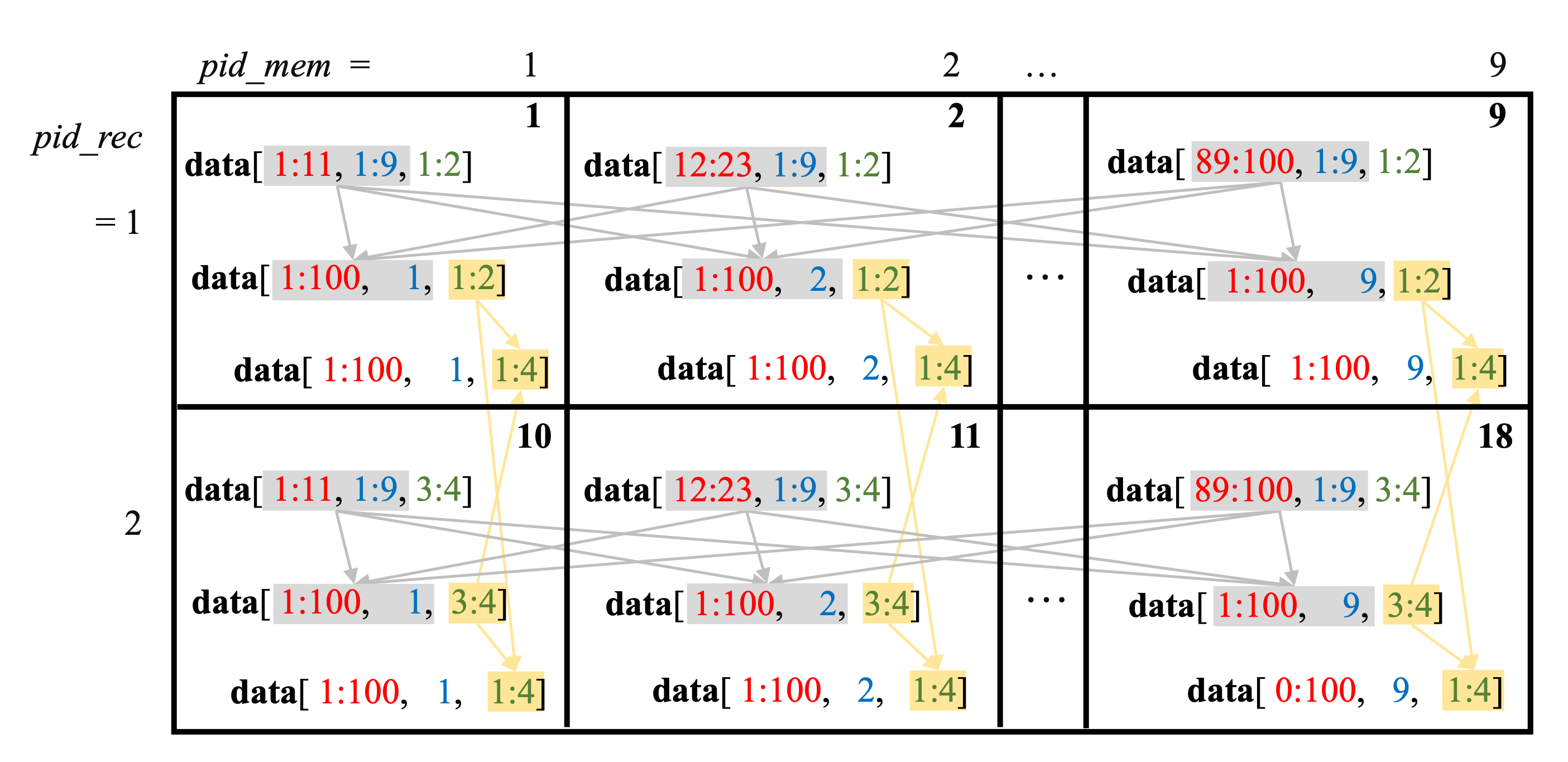
Schematic of the state and observation transpose operations.
Gray arrows: state transpose (field-complete fields_prior → ensemble-complete
state_prior). Yellow arrows: the additional comm_rec allgather that collects all
observation records needed by each processor for the local observation ensembles.
State transpose.
State.transpose_to_ensemble_complete(c, fields_prior) communicates within comm_mem
to move the field-complete fields_prior (FieldEns) into the ensemble-complete
state_prior (StateEns). The same transpose is applied to fields_z to produce
state_z. After assimilation, the reverse State.transpose_to_field_complete(c, state_post)
brings the ensemble-complete state_post back to field-complete fields_post so that
Updator.update(c) can write increments to the model restart files.
Observation transpose.
Within each comm_mem record group, only the processor with pid_mem == 0 reads and
processes the actual observations via collect_obs_seq(); the result is then broadcast to all
other pid_mem in the same group. All pid_mem independently compute observation priors
for their own members.
The transpose proceeds in two steps (performed separately for the observation sequence and the observation prior ensemble):
Within
comm_mem: send the field-complete observations/priors from the source processor to the destination processors so that each processor holds the full ensemble for its own subset of partitionspar_list[pid_mem].Across
comm_rec:allgatherallobs_rec_idwithincomm_recso that eachpid_rechas the complete set of observation records needed to update its ownrec_list.
Concretely, Obs.transpose_obs_seq(c, obs_seq) converts obs_seq (ObsSeq) to lobs
(LocalObsSeq), and Obs.transpose_to_ensemble_complete(c, obs_prior) converts obs_prior
(ObsEns) to lobs_prior (LocalObsEns). Both are called by
Assimilator.transpose_to_ensemble_complete(c).
Assimilation Modes
Once the transposes are complete, each processor holds the local ensemble
state_prior[mem_id, rec_id][par_id] (np.ndarray),
lobs[obs_rec_id][par_id] (dict[str, np.ndarray]), and
lobs_prior[mem_id, obs_rec_id][par_id] (np.ndarray).
Before calling the assimilation algorithm, both state and observation data are packed into flat
arrays via State.pack_local_state_data(c, par_id, ...) and
Obs.pack_local_obs_data(c, par_id, ...).
Batch mode (BatchAssimilator).**
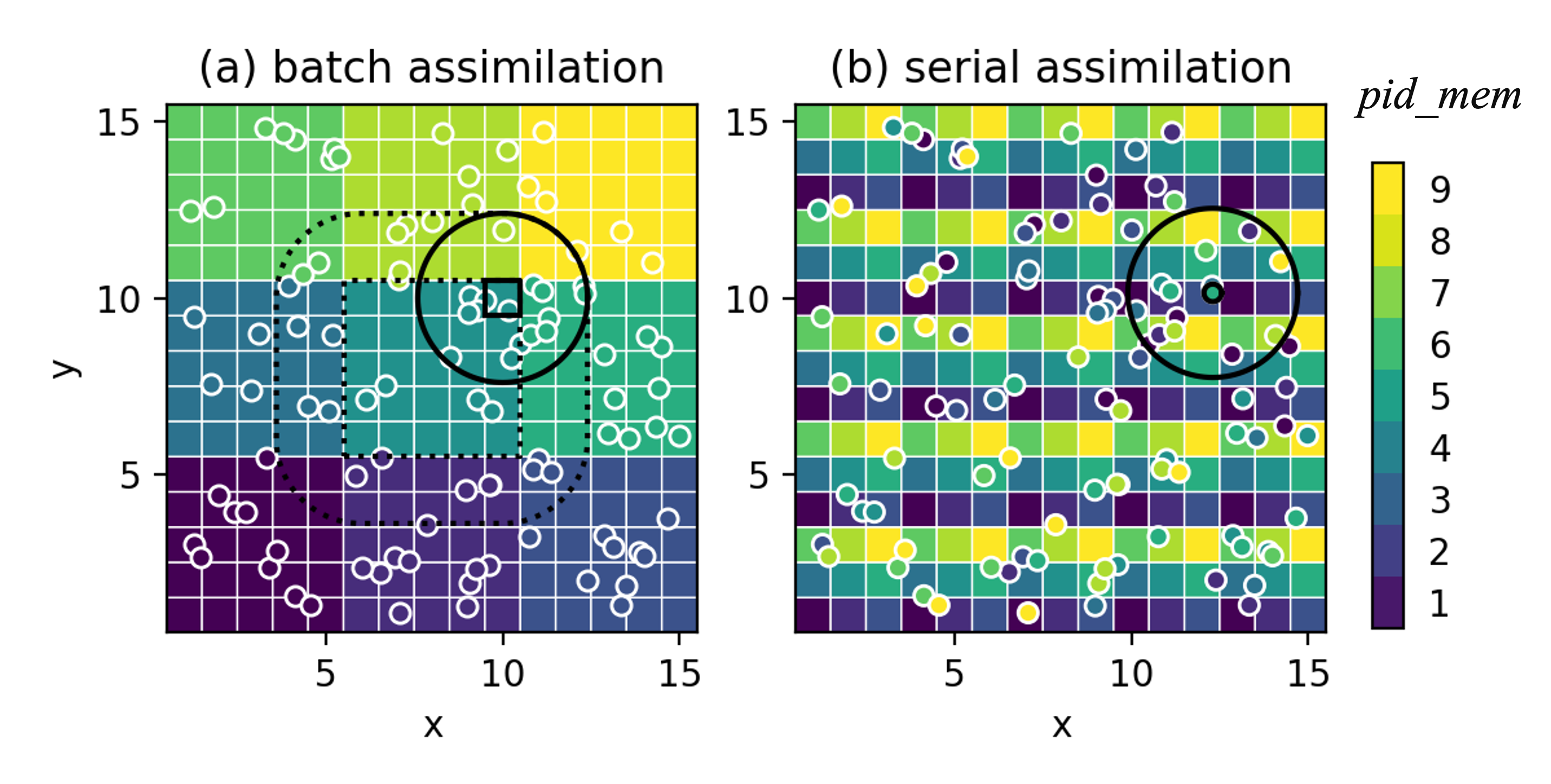
The analysis domain is divided into square tiles (par_id), with ~3 × nproc_mem tiles to
allow load-balanced distribution. BatchAssimilator.assimilation_algorithm(c) loops over
par_list[pid_mem]; for each tile it loops over unmasked grid points and calls
local_analysis(c, loc_id, ind, hlfactor, state_data, obs_data) with the subset of
observations within the horizontal localisation radius hroi. Implemented algorithms include
matrix-form ensemble filters such as
LETKF and
DEnKF.
Batch mode is favourable when the local observation volume is small or when the matrix formulation
enables more flexible error-covariance modelling.
Serial mode (SerialAssimilator).**
Partitions tile the domain so that each pid_mem owns one non-overlapping subset spanning the
full domain. SerialAssimilator.assimilation_algorithm(c) iterates over a global ordered list
of individual observations. For each observation the owning processor computes
obs_increment(obs_prior, obs, obs_err_std) and broadcasts it; all processors then call
update_local_state(...) and update_local_obs(...) to update the state and observation
priors within the localisation radius. Updated observation priors are reused for subsequent
observations, making the update iterative. Serial mode scales better for inhomogeneous networks
or large local observation volumes, and scalar updates enable nonlinear filtering approaches such
as particle filters or rank regression.
Assimilation Workflow
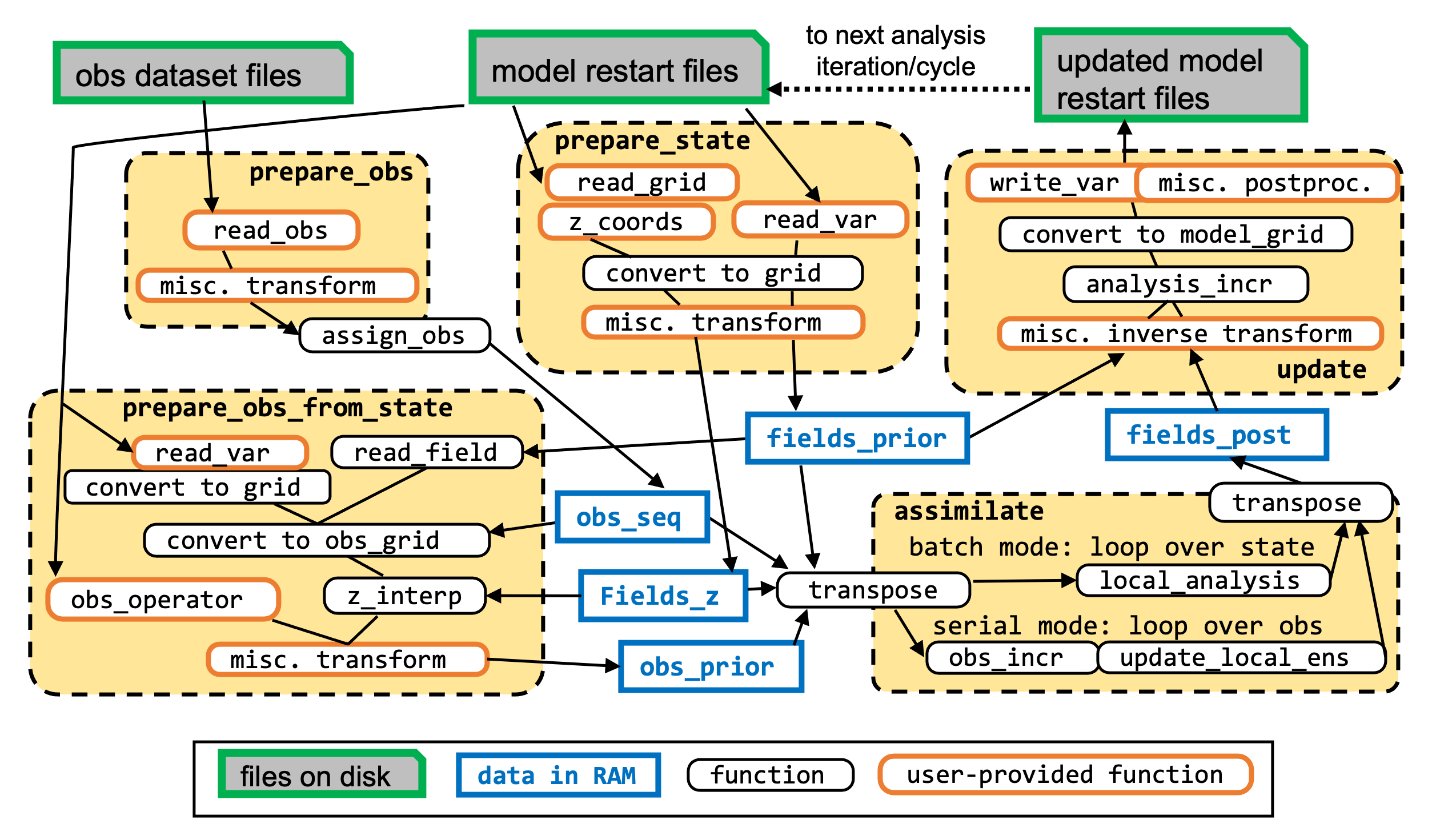
Workflow for one assimilation cycle/iteration. Key variables and functions are shown; black
arrows indicate the flow of information. User-provided functions (read_var, z_coords,
read_obs, obs_operator) are the interface between model/dataset modules and the core DA
algorithms.
Key Variables
Indices and communicators
pid— rank in the global communicatorcommof sizenproc.pid_mem— rank withincomm_mem(record group);pid_mem = pid % nproc_mem.pid_rec— rank withincomm_rec(member group);pid_rec = pid // nproc_mem.comm_mem— sub-communicator grouping all processors with the samepid_rec.comm_rec— sub-communicator grouping all processors with the samepid_mem.mem_list: dict[ProcIDMem, list[MemID]]— maps eachpid_memto its list of member indicesmem_id.rec_list: dict[ProcIDRec, list[FieldRecordID]]— maps eachpid_recto its list of field record indicesrec_id.obs_rec_list: dict[ProcIDRec, list[ObsRecordID]]— maps eachpid_recto its list of observation record indicesobs_rec_id.partitions: list— spatial partitions of the analysis domain. Each entry is either a slice tuple(istart, iend, di, jstart, jend, dj)(regular 2D grid) or an index array (irregular grid).par_list: dict[ProcIDMem, list[PartitionID]]— maps eachpid_memto its list of partition indicespar_id.obs_inds: dict[ObsRecordID, dict[PartitionID, np.ndarray]]— for eachobs_rec_idandpar_id, the integer indices into the full observation record that belong to the local observation subset for that partition.
Data structures
fields_prior: FieldEns—dict[(MemID, FieldRecordID), np.ndarray]. Field-complete prior state; each value is a 2D fieldfld[j, i](orfld[2, j, i]for vector fields).fields_z: FieldEns— same structure asfields_prior; holds z-coordinate fields for each record.state_prior: StateEns—dict[(MemID, FieldRecordID), dict[PartitionID, np.ndarray]]. Ensemble-complete prior state;state_prior[mem_id, rec_id][par_id]is the 1-D array of unmasked field values in the partition.state_z: StateEns— same structure asstate_prior; holds z-coordinate values in ensemble-complete layout.state_post: StateEns— same structure asstate_prior; holds the posterior (updated) state after assimilation.fields_post: FieldEns— field-complete posterior, produced by transposingstate_postback.obs_seq: ObsSeq—dict[ObsRecordID, dict[str, np.ndarray]]. Full observation sequence for each record; mandatory keys are'obs','x','y','z','t','err_std'.obs_prior: ObsEns—dict[(MemID, ObsRecordID), np.ndarray]. Observation priors computed from the model state; each value has the same length asobs_seq[obs_rec_id]['obs'].lobs: LocalObsSeq—dict[ObsRecordID, dict[PartitionID, dict[str, np.ndarray]]]. Ensemble-complete local observation sequence;lobs[obs_rec_id][par_id]has the same keys asobs_seqbut contains only the subset indexed byobs_inds[obs_rec_id][par_id].lobs_prior: LocalObsEns—dict[(MemID, ObsRecordID), dict[PartitionID, np.ndarray]]. Ensemble-complete local observation priors;lobs_prior[mem_id, obs_rec_id][par_id]contains the subset of observation priors for that partition.lobs_post: LocalObsEns— same structure aslobs_prior; holds the posterior observation ensemble (updated in serial mode only).
Key Functions
State.prepare_state(c)— for each(mem_id, rec_id)in the local task lists, calls the model module’sread_var()to read variables on the model native grid, converts them to the analysis grid, and applies user-defined transform functions. Also reads z-coordinate fields viaz_coords(). Populatesfields_priorandfields_z.Obs.prepare_obs(c)— callscollect_obs_seq()on the root of eachcomm_memgroup (pid_mem == 0), then broadcasts the result to all otherpid_memin the group.collect_obs_seq()calls the dataset module’sread_obs()for eachobs_rec_idinobs_rec_list[pid_rec]and applies transforms. Populatesobs_seq.Obs.prepare_obs_from_state(c, tag)— for each(mem_id, obs_rec_id)in the local task lists, callsstate_to_obs()to compute observation priors from the model state. Three paths are available: (1) read directly from the state if the observed variable is a state variable; (2) callmodel.read_var()and interpolate horizontally and vertically to the observation network; (3) call a user-providedobs_operator()from the dataset module. Populatesobs_prior.Assimilator.assign_obs(c)— abstract method implemented differently in each assimilation mode. In batch mode: for eachobs_rec_id, finds the observation indices that fall withinhroiof each partition bounding box. In serial mode: divides the full observation sequence intonproc_memnon-overlapping subsets, one perpar_id. Returnsobs_inds: dict[ObsRecordID, dict[PartitionID, np.ndarray]].Assimilator.transpose_to_ensemble_complete(c)— orchestrates the full transpose step by calling:State.transpose_to_ensemble_complete(c, fields_prior)→state_priorState.transpose_to_ensemble_complete(c, fields_z)→state_zObs.transpose_obs_seq(c, obs_seq)→lobsObs.transpose_to_ensemble_complete(c, obs_prior)→lobs_prior
BatchAssimilator.assimilation_algorithm(c)— loops overpar_list[pid_mem]; for each partition packs state and observation data into flat arrays, then loops over unmasked grid points and callslocal_analysis(c, loc_id, ind, hlfactor, state_data, obs_data)to compute the matrix-form local analysis. Writes results tostate_postviaState.unpack_local_state_data(c, par_id, state_post, state_data).SerialAssimilator.assimilation_algorithm(c)— builds a global ordered observation list viaObs.global_obs_list(c), then iterates over individual observations. For each observation: the owningpid_memcallsobs_increment(obs_prior, obs, obs_err_std)and broadcasts the result; all processors callupdate_local_state(...)andupdate_local_obs(...)to iteratively update the state and the observation priors in their local partitions.Assimilator.transpose_to_field_complete(c)— callsState.transpose_to_field_complete(c, state_post)→fields_postand, in serial mode,Obs.transpose_to_field_complete(c, lobs_post)→obs_post.Updator.update(c)— computes analysis increments by callingcompute_increment(c)(which comparesfields_priorandfields_post), then applies them to the model restart files viaupdate_files(c, mem_id, rec_id)for each(mem_id, rec_id)in the local task lists. User-defined inverse transforms and post-processing steps (e.g. optical-flow alignment) can be inserted in theUpdatorsubclass.
Extensions
The modular design allows the following extensions without changing the core assimilation code:
Ensemble smoothing — add multiple time steps in the
timedimension of the state and/or observations.Iterative smoothers — run the analysis cycle as an outer loop (controlled by
config.niter).Multiscale DA — use spatial bandpass filtering transforms to assimilate each scale component separately (controlled by
config.resolution_level).Gaussian anamorphosis — apply a transform to map non-Gaussian variables to a Gaussian space before assimilation.
Nonlinear observation operators — provide a custom
obs_operator()in the dataset module to map state to observation space via, e.g., a neural network or radiative transfer model.