Software Architecture
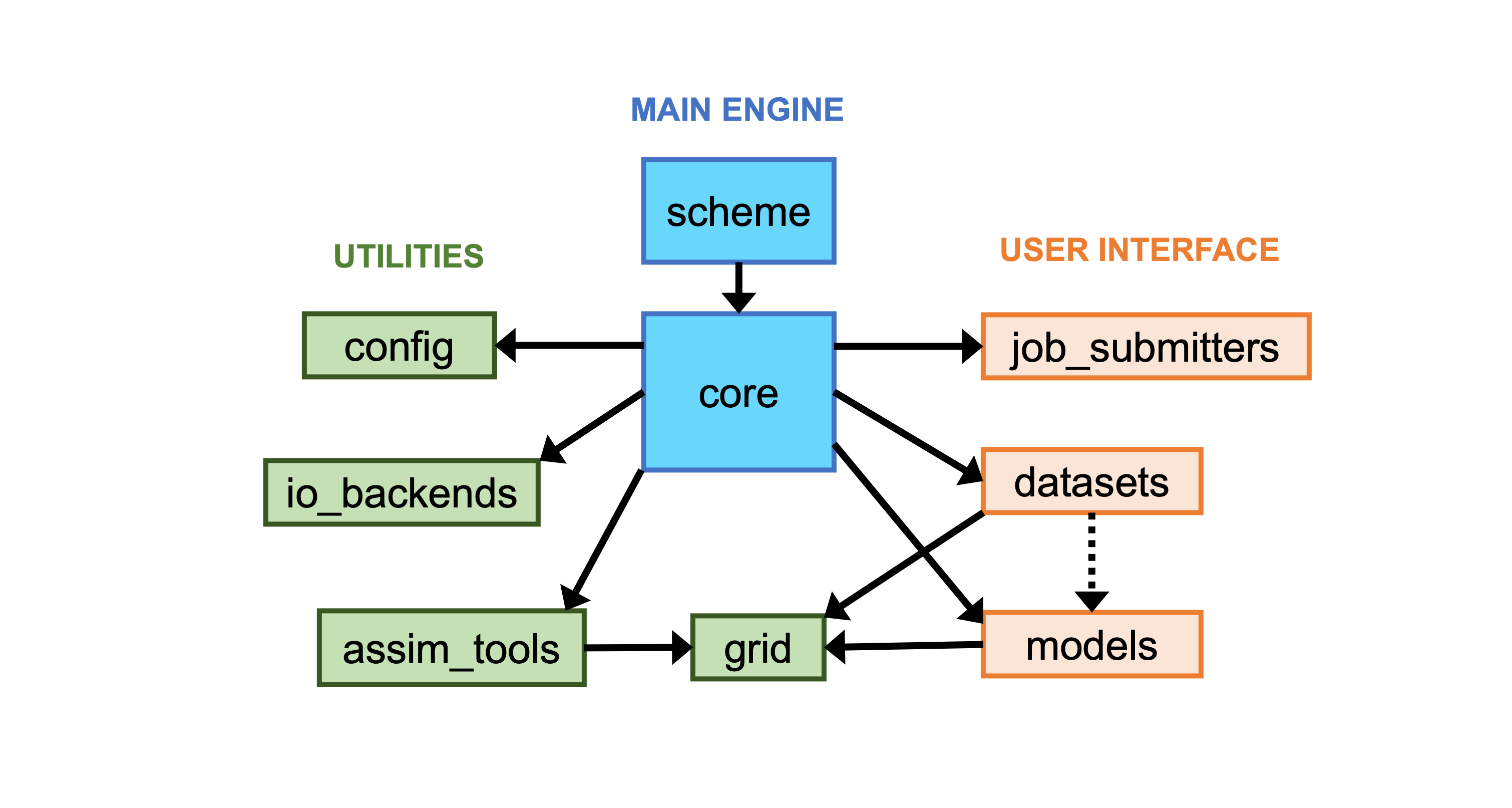
Overview of the NEDAS software architecture. Boxes in blue are the main engine that orchestrates the assimilation
workflow, providing base classes in NEDAS.core. Boxes in orange are user-provided implementations for interfacing with specific models and
datasets and running on specific computers. Boxes in green are utility functions and algorithm implementations in NEDAS.assim_tools.
Design Philosophy
NEDAS separates the DA workflow into three concerns:
Orchestration — when and how each step runs (handled by
SchemeandContext).Algorithm — what computation transforms the prior ensemble into a posterior (handled by
Assimilator,Updator,Inflation,Transform).Interface — how model state and observations are read and written, and jobs are run (handled by
Model,Dataset,JobSubmitter).
Each concern is encapsulated behind an abstract base class (ABC). Concrete implementations are discovered and instantiated at runtime via factory functions, so adding support for a new model, observation type, or DA algorithm requires only a new subclass — the orchestration layer does not change.
Package Map
NEDAS/
├── config/          # Config class; YAML parsing and validation
├── core/            # Abstract base classes (the framework)
│   ├── context.py   # Context  — runtime state manager
│   ├── scheme.py    # Scheme   — workflow orchestrator (ABC)
│   ├── state.py     # State    — ensemble state (field/ensemble-complete layouts, transposes)
│   ├── obs.py       # Obs      — observations (obs sequence, priors, transposes)
│   ├── model.py     # Model    — forecast model interface (ABC)
│   ├── dataset.py   # Dataset  — observation dataset interface (ABC)
│   ├── assimilator.py  # Assimilator — DA algorithm (ABC)
│   ├── updator.py      # Updator     — restart-file update (ABC)
│   ├── inflation.py    # Inflation   — ensemble inflation (ABC)
│   ├── transform.py    # Transform   — state/obs transforms (ABC)
│   ├── io_backend.py   # IOBackend   — file vs. memory I/O (ABC)
│   ├── job_submitter.py # JobSubmitter — HPC dispatch (ABC)
│   └── types.py        # Type aliases and dataclasses (FieldRecord, ObsRecord, …)
├── schemes/         # Concrete Scheme implementations
│   ├── filter.py    # FilterAnalysisScheme — cycling filter analysis
│   └── forecast.py  # ForecastScheme       — ensemble forecast only
├── assim_tools/     # Concrete algorithm implementations
│   ├── assimilators/   # ETKF, TopazDEnKF (batch); EAKF (serial)
│   ├── updators/       # AdditiveUpdator, AlignmentUpdator
│   ├── inflation/      # MultiplicativeInflation, RTPP
│   ├── localization/   # distance_based, correlation_based
│   ├── covariance/     # ensemble, static
│   └── transforms/     # identity, scale_bandpass
├── models/          # Forecast model implementations
│   ├── vort2d/      # 2D vorticity (Python, for tutorials)
│   ├── lorenz96/    # Lorenz 1996 (Python, for tutorials)
│   ├── qg/          # Quasi-geostrophic (Fortran, emulator, and naitive Python)
│   ├── nextsim/     # neXtSIM sea-ice model (v1 and DG)
│   ├── topaz/       # TOPAZ coupled ocean–ice (v4 and v5)
│   └── wrf/         # WRF atmosphere
├── datasets/        # Observation dataset implementations
│   ├── synthetic/   # Synthetic (OSSE) observations
│   ├── vort2d/      # Observations for the vort2d model
│   ├── osisaf/      # OSISAF sea-ice concentration and drift
│   ├── amsr2/       # AMSR-2 passive microwave
│   ├── cs2smos/     # CryoSat-2 / SMOS sea-ice thickness
│   ├── ifremer/     # Argo float profiles
│   └── rgps/        # RGPS sea-ice deformation
├── grid/            # Grid classes (regular, irregular, 1-D)
├── io_backends/     # OfflineIOBackend, OnlineIOBackend
├── job_submitters/  # local, macOS, SLURM, OAR, Betzy, GRICAD
├── diag/            # Diagnostics and plotting utilities
└── utils/           # parallel (MPI), conversion, FFT, netCDF helpers
Core Abstractions
Context
Context is the single runtime object that all other components share.
It is created once by Scheme.__init__() and passed as the first argument c to every
method in the framework. It holds:
MPI communicators
comm,comm_mem,comm_recand the derived indicespid,pid_mem,pid_rec.The analysis grid (
c.grid), ensemble size (c.nens), current time (c.time), and iteration counter (c.iter).References to all active
ModelandDatasetinstances (c.models,c.datasets).The algorithm components created at the start of each outer-loop iteration:
c.assimilator,c.updator,c.localization_funcs,c.inflation_func,c.transform_funcs.The
State(c.state) andObs(c.obs) objects that hold ensemble data in memory.
Scheme
Scheme is the top-level workflow orchestrator. Its __call__() entry point checks the
runtime environment and either runs run_all() directly (serial or already-inside-MPI) or
re-dispatches itself into an MPI-enabled subprocess via external_call().
run_all() is implemented by each concrete subclass and calls run_step() for each
named step. run_step() decides whether to execute locally or to spawn an MPI subprocess,
according to steps_need_mpi.
Currently available schemes:
FilterAnalysisScheme— cycling DA experiment. Steps:prepare_truth,prepare_init_ensemble,preprocess,perturb,filter,postprocess,ensemble_forecast,diagnose. Thefilterstep runs one or more outer-loop iterations offilter_iter(), each invokingState.prepare_state→Obs.prepare_obs→Obs.prepare_obs_from_state→Assimilator.assimilate→Updator.update.ForecastScheme— ensemble forecast without assimilation.
Model and Dataset
Model and Dataset are the user-extension points. Each concrete subclass is placed in its
own directory under NEDAS/models/ or NEDAS/datasets/. The directory must contain a
default.yml with default configuration values; the class reads them via parse_config().
Key methods that a Model subclass must implement:
read_grid(**kwargs)— read the model grid from files and populateself.grid.read_var(**kwargs) → np.ndarray— return a 2D (or 3D) field for a given variable, time, member, and vertical level. In offline mode this reads from restart files; in online mode it reads fromself.memory.z_coords(**kwargs) → np.ndarray— return the vertical coordinate field at a given level.run(**kwargs)— advance the model forward by one forecast period.Optionally:
preprocess,postprocess,generate_truth,generate_init_ensemble.
Key members that a Dataset subclass must implement:
variables: dict[VarName, VarDesc]— the set of observable quantities this dataset provides.read_obs(**kwargs) → dict[str, np.ndarray]— return an observation sequence dict with keys'obs','x','y','z','t','err_std'.Optionally:
obs_operator: dict[VarName, Callable]— nonlinear observation operators for variables that cannot be obtained directly frommodel.read_var().
Assimilator and Updator
Assimilator defines the three abstract methods that a DA algorithm must implement:
init_partitions(c)— partition the analysis domain.assign_obs(c)— map each observation to its relevant partitions.assimilation_algorithm(c)— updatestate_prior→state_postusinglobsandlobs_prior.
assimilate(c) is the non-abstract driver that calls partition_grid(), the two transpose
steps, assimilation_algorithm(), the reverse transpose, and the posterior output.
Updator maps the posterior back to the model restart files:
compute_increment(c)— compute the differencefields_post - fields_prior.update_files(c, mem_id, rec_id)— apply the increment to the model restart file for the given member and field record.
Available algorithm implementations:
Class |
Mode |
Description |
|---|---|---|
|
batch |
Ensemble Transform Kalman Filter |
|
batch |
Deterministic EnKF used in the TOPAZ system |
|
serial |
Ensemble Adjustment Kalman Filter (DART-style) |
|
— |
Adds analysis increment directly to restart fields |
|
— |
Derives optical-flow displacement from the increment and applies it |
IOBackend and JobSubmitter
IOBackend abstracts the data pathway:
Offline (
OfflineIOBackend) — state and observations are exchanged through binary files on disk. This is the default and supports arbitrary parallel file systems.Online (
OnlineIOBackend) — state is held in Python dictionaries in memory (model.memory), avoiding file I/O entirely. Suitable for lightweight models such asvort2dandlorenz96.
JobSubmitter abstracts job dispatch:
local/macos— runs tasks as local subprocesses.slurm/oar/betzy/gricad— submits tasks to HPC batch schedulers.
The scheme selects the appropriate backend via io_mode and job_submit in the
configuration file; the rest of the code is unaware of which backend is active.
Runtime Flow (Filter Scheme)
The sequence below describes one outer-loop iteration of FilterAnalysisScheme.filter_iter():
Context.update_assim_tools()— (re-)instantiatesAssimilator,Updator,Inflation, andTransformobjects for this iteration. For multiscale DA the analysis grid resolution is also updated here.State.prepare_state(c)— each processor reads its subset of(mem_id, rec_id)fields from the model restart files viamodel.read_var(), converts them to the analysis grid, applies transforms, and populatesfields_priorandfields_z.Obs.prepare_obs(c)— the root of each record group reads the observation sequence viadataset.read_obs()and broadcasts to its group, populatingobs_seq.Obs.prepare_obs_from_state(c, 'prior')— each processor computes observation priors from its subset of members, populatingobs_prior.Assimilator.assimilate(c):Prior inflation (
Inflation).partition_grid()— partition the domain, assign observations to partitions.Transpose
fields_prior/fields_z/obs_seq/obs_priorto ensemble-complete layout (state_prior/state_z/lobs/lobs_prior).assimilation_algorithm()— computestate_post(andlobs_postin serial mode).Transpose
state_postback to field-completefields_post.Posterior inflation (
Inflation).
Updator.update(c)— compute increments fromfields_prior/fields_postand write them back to the model restart files.